Showing posts with label Dumb. Show all posts

Thursday, April 2, 2026

The Other Appendix N

Because I know that nobody reading this right now has ever read the D&D 5.0 Dungeon Master's Guide, that also means you almost certainly don't know about one of its best treasures: APPENDIX D: DUNGEON MASTER INSPIRATION (page 316).

This is separate from the "Inspirational Reading" list included in the Player's Handbook, itself based on the classic "Appendix N" from the 1st Edition of Advanced Dungeons & Dragons. While that list consists entirely of works of fantasy fiction, the DMG's list is instead a collection of resources that the 5E development team thought might be helpful for you to hone the skills of dungeon mastering. And I gotta say, I quite like this list.

I've transcribed the full page below, with some thoughts of my own at the end.

Wednesday, January 22, 2025

My dumb labels are better than your dumb labels

Even though the OSR as a living movement is largely stagnant, there's more folks being attracted to it than ever before. A consequence of that has been a shift in how people discuss and label things. I'm not trying to talk trash about Johnny-come-latelies or anything. It's exciting to have so much interest in this playstyle. But I think it's fair to say that they bring a bit of an outsider perspective that's lacking the context of where and how this play culture was born and developed.

I think that, even to this day, the first thing you learn about the OSR is that nobody knows what "OSR" means. But honestly, there arose a pretty solid framework relatively early on that I think made discussion a lot easier.

The early OSR was dominated by the "Revivalists," folks mostly just playing TSR editions of D&D or perhaps retroclones (and sometimes paraclones) of those editions. OSRIC, Labyrinth Lord, Lamentations of the Flame Princess, etc. These folks were a lot more devoted to the TSR adventures like Keep on the Borderlands and are the most likely to put up a spirited defense of THAC0.

At some point there was a shift towards the "Renaissance," folks applying iterative design to old-school ideas to create new and innovative games. Largely the same playstyle, but oftentimes more slick and smooth and maybe easier to read and teach. GLOG, The Black Hack, Maze Rats, Into the Odd, ICRPG, etc.

There's arguably a third interpretation, the OSR as "Revolution." Rather than describing an abstract philosophy towards gaming, this refers to OSR as a social phenomenon. Get a movement going, write everything down for posterity, get a name, brand your products with the term (and maybe a cool OSR logo?), actively campaign for ENnie awards, try to influence name-brand D&D. With this came some embarrassing drama, cults of personality, and a splintering into countless subfactions. In truth, the "Revolution" isn't really a third interpretation, but rather a separate axis that those involved in the OSR had widely varying levels of interest in.

All of that seems to still make perfect sense to me. If anything, I seem to recall a general feeling that the Renaissance crowd was definitely where the OSR's momentum was found, whereas the Revivalists were being retroactively characterized as merely a continuation of something that had already long existed (what would now be called "Classical").

Skip ahead 10+ years and now I see a bunch of AD&D fanboys hijacking the term, claiming that the Revivalists are the only true OSR, while others instead retroactively apply terms like "NSR" onto everything that came out of the Renaissance crowd (despite them predating it by many years). I can't imagine how incomprehensible a lot of the old blogosphere must be to anyone coming into the conversation now, especially when they keep seeing the term "new school" frequently being used to refer to games like D&D 4E and Pathfinder.

It would almost be like if I coined a new term to refer to a new movement of games, "Powered by the Armageddon" or just "PbtA" for short, completely unrelated to Powered by the Apocalypse, and it somehow caught on, and started even being retroactively applied to games made 5+ years ago. Wouldn't that make talking about RPGs and reading old threads super annoying?

Maybe I'm just old and cranky.


-Dwiz

Tuesday, October 8, 2024

In the Mouth of Madness


"Go on in, it's okay. You can see him."

The Dungeon Master was frozen at the door. He was nervous for what he'd find on the other side. But that was his player in there. His friend. After a moment's hesitation, he stepped inside. Just ahead, there were the bars of a secure cell visible. He could hear the Rogue's voice. He was saying something, something unclear. The nurse saw that the Dungeon Master was unsure, and so she stepped inside with him.

"Rogue, you have a visitor. Your Dungeon Master has come to see you."

The Dungeon Master crept further and saw through the cell bars. On the other side was the Rogue. He was pale and trembling. His arms were bound and his surroundings were padded. Their eyes met, but there was no recognition in the Rogue's gaze. He just continued muttering.

"It doesn't even give the length. Not in feet, not in meters, not in squares, nothing."

"The length of what, Rogue?" asked the Dungeon Master.

"Why are those words capitalized? Why are so many words capitalized?"

It was no use. He wasn't talking to them at all. He wasn't in the same room as them, in the same world as them. The Dungeon Master choked. It was too difficult for him to see. His friend of so many years, now a total stranger. The Rogue had changed.

Wednesday, September 18, 2024

A Response to the Esteemed Dr. Crackpot

That's the title of a little journaling game a friend of mine got off of itch.io, created by Emily Jankowski. You can get it here as a PWYW, although I've also included the game in its entirety below.

I thought this was pretty fun sounding, and so my DM and I gave it a spin. I offered a few suggestions for our scientific field, he picked Faster-Than-Light travel and wrote the first entry (Dr. Lucas Krag). I wrote as Dr. Tycho March. You can read our full correspondence as a pdf here, in all its unedited glory. I hope you enjoy.

Spoilers: Dr. Krag won the fist fight, but was then escorted off the premises by security and lost any semblance of a career he had left.


-Dwiz

Friday, January 12, 2024

New Year’s Resolution Mechanic: Taking Your Time

This is a joke for everyone except Warren to get

Prismatic Wasteland has issued a challenge to come up with a new mechanic for basic task resolution in RPGs. While I appreciate crossovers, ping pong posting, and pretty much anything that promotes active blogging, I also must state that I find this whole premise downright disgusting, and take great personal offense to it.

So anyway here's my submission to the challenge. It's not a good one. Overthinking simple stuff is rarely fruitful for a pea-brain like me.

This post is in four parts. First, I have to rant for a bit about theoretical bullshit for context. Second, I finally explain the rule. Third, I talk a bit about what inspired it and what I like about it. Fourth, I have an alternative to my rule that's much less fleshed out.

Thursday, August 31, 2023

The Least Interesting Type of Crunch

As I'm sure you well know, not all crunch is the same. It can be broadly useful to know if you generally prefer less crunch or more crunch. But it helps a lot to feel out the nuance of the issue. I myself don't often identify as preferring "rules lite" games anymore because I have to admit that there's actually some very crunchy games I love. My own design certainly leans lite, but I know confidently that I'm no true minimalist. I can sink my teeth into rules and procedures, so long as they're the right kinds. But I think I've discovered the one category of crunch that I find the least interesting overall. And I'm sure many of you out there will vehemently disagree.

Rules, resources, and procedures that complicate basic task resolution do basically nothing for me 99% of the time. I cannot get excited over this sort of thing. And the worst part is, this is also the focus of, like, 75+ percent of all RPG design discussion. Just go onto reddit.com/r/RPGdesign and see how much of it is literally just talking about dice mechanics.

Don't get me wrong. I'm well versed in this area. I can talk about it for fucking days. Right now, off the top of my head, I can name and explain at least 20 different core mechanics from RPGs I've seen or read or played. I can tell you all about the strengths and weaknesses of d20s, d6s, 2d6s, d%, or whatever. Binary pass/fail? Variable difficulty or static difficulty, then? Or what about noting margins of success? Or if you're a PbtA fan, gradations of success then? Please. Roll-under or roll-over? How about roll-under blackjack? Hell, some games exclusively use contested rolls for all checks. And yet, others have exclusively player-facing rolls. Dice pools are cool, but you know what's cooler? Measuring attributes in die sizes themselves. But I'm sure some of you enlightened ones are about to preach the gospel of narrative dice, or FUDGE dice, or Zocchi dice. And how do we feel about modifiers? +/- X is a bit clunky, but we could go back to matrices. Advantage/Disadvantage is pretty slick, but have you heard of Boons and Banes? Personally, I really like Momentum from the 2d20 engine. Effort dice to deal "damage" to a task is cool, too. But sometimes you just gotta go for exploding dice, right? And yet, is anything more elegant than two attributes sharing a single stat, as in Lasers & Feelings? We haven't even touched criticals and fumbles, either. Oh Jesus Christ how the fuck do you begin to explain FASERIP??

And yet... I don't give a shit. I just don't care. If the most interesting part of a game is its dice mechanic then I probably won't be able to get into it.

I recently tried looking up "gimmick mechanics" in RPGs. Y'know, little pieces of design that aren't exactly foundational or revolutionary, but which still make you go "oh that's cute." I love gimmick mechanics. I wanted to collect a list. On occasion I'll revisit it, and maybe consider bolting one or two of these gimmicks onto whatever project I'm working on that week. And the list is coming along okay. But you know what I found in my search? Almost exclusively fucking dice mechanic variations. Things that just interact with the probability of success or failure at basic tasks.
  • D&D 5E has inspiration. Do a cool thing, DM gives you inspiration. Spend it to get free advantage to one die roll. Only 1 inspiration at a time, so you better use it.
  • Fate has fate points. Everyone starts with a pool of fate points they can spend to either get +2 on a roll or to re-roll, whichever would be better. But to spend it, you need to invoke one of your traits and make it relevant to the fiction somehow.
  • Paranoia: Red Clearance Edition has the Computer Dice. It's the one die you always get to roll in your dice pool no matter what, but gets weird if it rolls the computer symbol. You gotta erase a point of Moxie and see how Friend Computer intervenes, which could be helpful or harmful.
  • Savage Worlds has the wild die, exploding dice, and bennies to spend for dice re-rolls. Do I have to explain all three? Go look it up.
  • Blades in the Dark has the "devil's bargain," where the player can add an extra die to their dice pool in exchange for a narrative complication.
  • Kult: Divinity Lost has relation inspiration. You have certain character relationships that are valuable to you. Then, whenever you can invoke the power of one of these relationships during a roll, you can get a bonus on it. Lifting a car to free someone underneath is difficult, but it's less difficult if the person is your own child.
  • Lots of Free League games include the "push" mechanic. Take some damage for the chance to re-roll some dice.
  • Troika! has an attribute called Luck. It's used in all sorts of places, usually just to see if things "go in your favor." But every time you test your luck, it lowers by 1 no matter what.
  • Call of Cthulhu has both a spendable Luck stat and a "pushing the roll" mechanic, which cannot interact with each other!
  • Every Star Wars RPG has had some kind of metacurrency. The 80's WEG one has "force points" The 00's WotC one has both "force points" and "destiny points." The 10's FFG one has "destiny points." All of these work differently. All of them are something you earn by being cool and you spend to make things work out better.
I'll admit that Dread really did something special in this area. But it's a rare sort of innovation.

The folks at Critical Role are currently coming out with a new game of their own. You may have heard of it. It's called Candela ObscuraHere's a video of a developer explaining the basics. I watched it. It seems like a fine game to me. I'm sure lots of folks will have a blast. But I just can't get past how much shit is involved in basic task resolution. To recap:

You have a score from 0-3 for each Action, determining how many dice you get in your pool when you roll that Action. Actions are nested in categories called Drives. When you roll an Action, you can also spend points to add extra dice from the pool attached to its parent Drive. You refresh Drive points by using one of your Gilded Actions. When rolling a Gilded Action, you replace a die in your pool with a Gilded die and can choose to take its result instead. Even though it may be worse, it at least restores a Drive point. And you also have Resistances, which you can spend to re-roll dice when you fail a roll.

Dear god that is so fucking boring. What could justify this degree of overthinking dice rolling?

I think one thing I've found during all my years running and playing games is that I want basic task resolution to be as quick and seamless as possible. I get unreasonably annoyed even just when one of my players takes 10 seconds to find the right die to roll, or they're struggling to type out the exact roll command on a VTT. Hell, I announce difficulty classes out loud when I call for a roll in the vain hope that I can maybe get the player to skip a couple steps and instead answer me with a simple "I succeeded" or "I failed."

I'm not an FKR purist, mind you. I enjoy that style of play, but I do prefer the uncertainty that dice can add to the equation. It's a crucial piece of design for me. I am pro-dice. But it's an ingredient of the design where I firmly believe that less is more.

Every piece of crunch you add has a cost. A cost in how much brainpower it takes to learn, to teach, to remember, to use. The essential tradeoff is to make sure that crunch is able to add something really valuable to the game in spite of that cost. I try to only add crunch in the parts of the experience that I think have the most potential for interesting decision-making. And in my opinion, "will I be successful at the thing?" is one of the most shallow questions to ask for inspiring decision-making opportunities.


-Dwiz

Monday, August 21, 2023

Samwell Tarly the Slayer vs Ghost the Good Doggo

D&D didn't forget about or abandon followers, flunkies, and lackies. They merely evolved. Adapted to selection pressures, now built for a different ecosystem. Now D&D has animal buddies. And there's actually a lot to this, I swear.

The two most popular kinds of sidekick are followers and pets. I want to use general terms here because old schoolers will get hung up on the distinctions between hirelings, henchmen, and retainers while new schoolers will get hung up on the distinctions between animal companions, mounts, familiars, and other summons. But that's missing the point.

Obviously, both old school D&D and new school D&D can and do make use of both followers and pets. But they definitely each have a preference. Modern DMs have to choose to add followers into the game, often because they specifically want to add a pinch of old school! And old-minded DMs rarely are prepared for when their younger players inevitably ask to have a pet, and at best might homebrew some "animal taming" procedure to feel better about it. I'm just here to point out that each one is better adapted to the norms and expectations of each play culture, yet are fundamentally variants of the same basic thing.

Followers are better suited to old school play because they're good for carrying items and holding light sources. Modern D&D doesn't care about either of those things. They're also a great backup character if your PC dies. But as far as modern D&D is concerned, an unplanned PC death is basically a complete fail state. It's like the worst thing that could possibly happen in the game and it means that someone, probably the DM, supremely and unforgivably fucked up. Followers are also an active agent to some degree, with their own motive, voice, and concerns about what they're sent to do and how they're treated. This holds potential for interesting social conflict, but it's a type of conflict that modern D&D doesn't have much interest in exploring or validating. Whereas an old school adventurer has to make a choice about whether they're abusive or fair to their followers, modern D&D would simply rather not allow them the opportunity to be abusive to anyone at all.

Pets are better suited to new school play because they don't have motives or agency or much of a voice. They can instead act as a fun accessory for their PC, making them look cooler. Remember, the PCs are much more the focal point of the game nowadays. Time and attention are finite resources, so anytime an NPC is getting the spotlight, it comes at the direct expense of the PCs. Followers are also more mechanically complicated. Pets are simple to run, which is good because PCs are now more complicated to run than in olden times. A pet can just be an extension of the PC, not unlike a mage hand. Of course, they can have personality. The players who want pets the most would all agree that the best part about a pet is when they're cute and fun and charming. There aren't many folks interested in a pet strictly for its practical benefits. That said, they do still have those!

The main utility a pet has in modern D&D is to serve as scouts and spies. That's a type of challenge that remains relevant in modern play, and my own group has to send out a pet to do some reconnaissance almost every single session. The second most common practical use for pets is to have them harass your opponents in battle so you can get advantage on your attack roll. This is a bit cheesy, but the prevailing ruling among the 5E community is to allow this idea (admittedly, probably mostly just so you can placate the player who really really likes their pet and wants it to be involved). Pet as an easy source of advantage means you don't have to be as clever about tactics. No need to work together with your fellow PCs (individual initiative is a modern design choice that already makes that less viable), no need to leverage the environment, no need to really read your opponent for their weaknesses. Just press the "activate pet advantage" button and move on to your attack roll.

I know this all makes me sound curmudgeonly and dramatic, but I sincerely like both of these playstyles and see the value in how each of these sidekick types complement them respectively. Followers make sense if the focus of the game is on navigating a landscape of complex, interactive challenge elements. Pets make sense if the focus of the game is to serve as a terrarium for your blorbos. But of course, everyone who's ever adopted the goblin NPC as a mascot for their party knows that followers can still satisfy blorbo appeal, and everyone who's sought out to tame a unicorn so you can have a powerful mount knows that pets can be treated as a very gameable asset even a rugged adventurer could see the use in.


-Dwiz

Sunday, July 30, 2023

This one's for all the aspiring Matt Mercers out there

This is the secret technique that you wouldn't find in "How I Run The Table." This one weird trick will supercharge your game and maximize player satisfaction. I call it...

The Family Guy-Style Cutaway Gag

All you Blades in the Dark fanboys can go blow yourselves, because flashbacks are for pussies. This is how real game masters spice up narrative flow. Allow me to teach it to you, if you can handle it.

Look at yourself. You're pathetic. You aren't funny. You're a gamer. But you're on the spot, your friends are waiting, and they expect to be entertained. How in all your hopeless ineptitude can you possibly make them laugh? Are you good at improv? Can you do impressions? Of course not. But all you need is your new best friend:

The rogue is probing the lock on the chest when he hears a sharp click. Family Guy-style cutaway to the elder lich watching you through his crystal ball at the center of the dungeon, saying to himself, "oh this is gunna be good."

Boom. Knocks em dead, every time. Instant laughter. Adulation. Dare I even say worship.

You want verisimilitude in your game? What better way to remind the players that the imagined world exists and lives independently of their PCs than by literally narrating as much.

You want character development? Worldbuilding? A threatening villain? Then interrupt your dumb players and tell them about it. Throw whatever scene at them you want, whenever you want.

You want your players to take a more active role in storytelling, filling out the world, and bringing it to life? I promise you, whether you like it or not, once you start using the Family Guy-style cutaway, your players will begin doing it too.

Now I cannot stress this enough: you have to verbally say "Family Guy-style cutaway" each time you use this technique. It's how you indicate to the players that you're doing it, so you can transition into the gag. If you don't, how will they know what the fuck is happening? Trust me, nobody ever gets used to this technique, probably because it's so refreshing and clever. So make sure you announce it because it can be difficult for your players to follow along if they aren't as smart as you.

I use the Family Guy-style cutaway gag every time I ever run a game, and also frequently in regular conversation and sometimes while I'm alone too. It's by far the most reliable way to maintain a smooth flow of play and active engagement from your players.

Better yet, make your players reveal their backstories exclusively through the use of comedically-timed Family Guy-style cutaways. They don't get to share it all up front. They have to wait for somebody to say, "Wait, you don't know how to swim?" so they can cutaway to some embarassing childhood experience where they got laughed out of the public pool. And if you aren't proactive enough, the other players will develop your character for you. "Wait, these NPCs all know your wife already?" Trust me, you don't want to wait and let the other players give that an explanation with their own cutaway gag.

Worried about splitting the party? Fret not. It's just an advanced application of the Family Guy-style cutaway technique. Jumping back and forth between two or more groups of players can and should always be paced according to comedic timing and situational irony.

If you really want to impress your players, you can level up your cutaways by breaking the fourth wall. Provide meta commentary on the action not by speaking out of character, but by employing a Family Guy-style cutaway in character which describes you and your players at the table, making an observation about the events in the game. That kind of self-referential layering of the experience is what people play D&D for.

This is, without exaggeration, the defining difference between true masters of the game and sad, bumbling, incoherent fools saddled with a responsibility far too great for their inadequate faculties of storytelling and drama.


-Dwiz

Wednesday, July 5, 2023

Christmas Adventures

[What better time for such a post than July 5?]

Because I make Halloween adventures, I have often been asked, "are you going to make a Christmas adventure next?"

The short answer is no. But because I've been asked so many times, I've put a lot of thought into it. Here's my full answer.

The first and most important reason why I wouldn't is that I don't really like Christmas. Some years I'm in more of a "it's just not for me" mood, but other years I can get pretty Grinch-y. And so I wouldn't really be the right person for the job. I hope that anyone who reads or plays Tricks & Treats can tell that I fucking love Halloween. But if I'm correct and that shows through in the finished work, then surely my lack of love for Christmas would show in any attempt I make at a Christmas adventure. It deserves to be made by someone who has enough passion to do the task justice.

But I also have a weirder, less convincing reason why. A train of thought where I've talked myself into believing that, ackchyually, a Christmas adventure would be inherently inferior to a Halloween adventure for XYZ reasons!

Saturday, April 1, 2023

The Forgotten Fire Bird of Castle Greyhawk

I haven't blogged in awhile, but I've still been spending a lot of my time on D&D-related things. I recently had an experience I simply have to share. I got a hold of some obscure and fascinating records from early TSR, honest-to-goodness RPG buried treasure.

Behold, the Alicanto, AKA Gary Gygax's "Dresden Bird":


Allow me to elaborate.

Wednesday, March 22, 2023

Spoiler-Free Review of Dungeons & Dragons: Honor Among Thieves

I just got out of an advanced screening of the D&D movie. It was better than I expected. Not great, but good. I have a lot of very negative things to say, but does anyone want to hear that? Maybe you'll enjoy hearing about some things I enjoyed (without spoilers, of course).

There are many moments in this movie that felt very authentic to the experience of playing an RPG. I don't really give a shit if it "wouldn't work in 5E." If anything, it was a pleasant surprise whenever I saw something that is in 5E. But leave it to a bunch of pedantic, joyless nerds to dwell on the accuracy of rules. This movie understood the far more important thing to get right: what it's like to play an adventure with your friends. Everyone brought a delicately-crafted snowflake PC to the table with some backstory prepared, maybe didn't read up on all the class features they have, sometimes forgot the magic items they got, created stupid running jokes throughout the campaign, and were doing their best to say badass one-liners and funny quips despite being a bunch of nerds sitting around someone's parents' dinner table.

In the first half of the movie, a criticism in the back of my head was, "this is a very mid D&D campaign." The Forgotten Realms remains a garbage setting, and this movie does nothing to redeem it. The DM definitely came up in the modern, story-focused tradition of running the game in "scenes" that they've strung together with some excuse plot which the players are asked not to depart from. The PCs are neither cliche nor are they creative. They are the exact sort of forgettable class+race+tragic backstory combos that most first-time D&D players come up with. "Tiefling druid raised by elves whose motivation is some vague thing about wanting to protect nature, but is still pliable enough that they'll work in the DM's campaign without much friction." A big part of me wished that it was more like, y'know, a good campaign. Maybe even a great campaign.

In the second half, I began to appreciate the value in it being, like, an extremely generic campaign instead. Because that's what most people who play D&D are going to experience. They'll run some shittily-made WotC 5E module set in the Sword Coast with a forgettable villain, listen to (and forget) tons of lore and backstory that both does-and-doesn't matter, and then, every once in awhile... they get to actually play. They're thrown into a scene with a weird and tricky problem to overcome, and they start trying to solve it. They debate, make plans, leverage their resources, make some hilariously stupid suggestions, and eventually succeed through a combination of lucky die rolls and genuinely good ideas, the kind that only D&D players can come up with.

Asking whether or not the movie is good is a bit useless. I have a far more interesting question.

Every now and then someone asks about what movies and shows "feel the most like D&D." The most commonly-agreed upon answers usually aren't high fantasy works like Lord of the Rings or Willow. Rather, they're the ones about characters going on quests, using their noggins to solve problems, usually working as a team, and overall just seem to be tackling challenges that feel like the sorts of thing a DM would cook up to entertain their friends for the evening. Tremors, The Expanse, Jim Henson's LabyrinthThe Mandalorian, Big Trouble in Little China, those sorts of things.

My one thing I was hoping for more than anything else is if this movie would be a fitting answer to that question. "What movies feel the most like playing D&D?" And it actually was.

Overall I rate it a 1/10, because it only had one dwarf in it.


-Dwiz

Wednesday, December 28, 2022

Product Identity? In MY Monsters?

It's more likely than you think.

Notorious bird Prismatic Wasteland is up to his antics again trying to get decent, law-abiding folks to weasel their way around legal trouble, and I'm here to help.

I put together a similar list a while back and I figure it's worth sharing.


First, More Names for the Monsters He Covered

Mind-Flayer: Bathalian (Reaper Minis), Cephalid (Dark Sword Minis), Mind Lasher (Old School Essentials), Octopoid/Gastropoid (The Black Hack), Philosophers (Zak S), Brain Fiend (Fantasy Craft), and, arguably, Genestealers (Warhammer 40K).

Beholder: Eye Tyrant (the alternate, generic name they already have in D&D), Eye Beast (Reaper Minis), Eye of Terror (Old School Essentials), Gazer (Dragon's Crown), Watcher in the Dark (Fantasy Craft).

Personally, the name I'm using is an Oculus.

Yuan-Ti: FUCK YOU WARREN, DEMON SNAKE MEN RULE

...Just... just get rid of the Orientalism, they'll be fine. Really.

I offer to you: Nagendra (Reaper Minis), Librarians (Zak S), and... that's all I could find. Really disappointed to see how many companies just go with "snake men" or "snake folk" for these guys.


Now, For Some Other Monsters

Bullywugs: Gullygugs (Old School Essentials), Boggards (Pathfinder), Squogs (Reaper Minis), Boglings (Greg Gillespie's adventures), and one of my own, Croaks.

Kuo-Toa: Deep Ones (Lovecraft, and seemingly the "default" name instead of "fish-folk" or something terrible), Dagonites (Otherworld Minis), Dagathonan (Dark Sword Minis), Pelagic (Darkest Dungeon).

Myconid (which isn't actually protected, but people like coming up with alternate names): Shrooman (Dungeon Crawl Classics), Funginids (Veins of the Earth), Fungoids (Reaper Minis), Sporling (Fantasy Craft), Mycelian (Old School Essentials).


Personally, what I really need is a good-sounding generic word for "bug-person." Can't (and don't want to) use "Thri-Kreen" or "Formian" from D&D, and everything else I've heard was way too setting-specific or bug-specific. What do y'all got?


-Dwiz

Saturday, August 6, 2022

8 Opinions about Spider-Man

Per the demands of Prismatic Wasteland, I have to write a blog post about Spider-Man. So what do I say about Spider-Man that hasn't already been said?

I decided my best bet would be to just create a shitty clickbait post with no real substance and lots of bad takes.

Saturday, July 30, 2022

HeroQuest: The Tourney of Champions

The best thing about HeroQuest is pitting your friends against one another in a vicious deathtrap!

I've just designed my first custom scenario for HeroQuest, which I intend to play with one of my board gaming groups when we meet in a few weeks. It's a big group, so I had the idea of a competitive scenario where you split the players into two teams and have them fight one another in the dungeon. I have no idea how well this will work, if it's balanced at all, if we'll be able to get through it in one session, etc. It makes use of lots of materials from all the expansions because I backed the crowdfunding campaign and got them all as rewards, and I want to try using those pieces finally. I figured I would make the zaniest funhouse dungeon I could, y'know?


-Dwiz

Monday, April 25, 2022

Potpourri

Artist Credit: Kieran Yanner
My blog output has been slow this year. Partially this is because I've started several very long posts that are each taking a while to finish, but mostly it's because I spend most of my time working now and have very little time left each day to do anything. I wanted to come up with something a bit smaller that could work as a good blog post to get out before the end of the month that isn't one of those huge posts, but I struggled. Everything I came up with was too small. So why not just offer all of them at once?

In this post you'll find seven really small RPG-related things I'd like to share which are all completely unrelated to one another. I hope the comments are chaos. They include:

  1. An idea I had for a particular take on the "Grit vs Flesh" mechanic
  2. A weird experimental PC I recently tried
  3. Possibly the most famous example of the power of tactical infinity in RPGs
  4. A world map I've slowly been working on
  5. An idea I have for a new monster type to fit into the traditional D&D schema
  6. How I would run a sandbox in a superhero game
  7. Doppelgängers

Monday, March 21, 2022

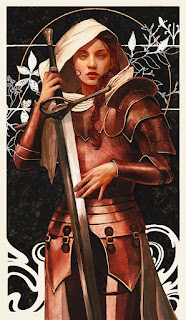
Women Warriors

Credit: Malaysian artist Qistina Khalidah, who
you should all go check out immediately

Female Fighters

Lady Lancers

Nonbinary Knights

I have a ton of folders of collected artwork for D&D inspiration. I was just thinking to myself that they could make for a good post. Why not start here? 

I hope you like women in armor, because I have many digital binders full of 'em. This collection skews towards European knight aesthetics because I'm a hack. Feel free to correct that in the comments by contributing more pics. 

I've tried to credit everyone. This isn't exhaustive or anything, these are just the pieces I've come across over the years that I enjoyed enough to save.

This one goes out to all the thirsty lesbians reading this blog. If it's popular then I'll do more of these posts (but with different subject matter).

Wednesday, January 12, 2022

Literary Allusions

This is another one that's more just about fantasy fiction in general, not specific to RPGs. Take it or leave it.

I'm not going to try to claim there's some brilliant and noble reason why this is a good or effective writing tool. I think it's just a lizard brain thing somehow. But let's say you're writing a work of fiction. Maybe some fantasy worldbuilding stuff, maybe not. But you need to impart some ideas and you want them to really resonate with the audience. Isn't it weird that one of the most reliable ways to do this is to just, like, reference an older, familiar work that talked about the same thing?

Sunday, January 2, 2022

Top 10 Philosophical Conundrums We Were Forced to Resolve in our D&D Game

Don't let anyone ever tell you that D&D 5E (or any high-magic game, for that matter) is easy on the DM to run. You think crunch is demanding? Try this shit:
  1. The definition of Personhood
  2. Zeno's Paradox (specifically the famous "dichotomy" one with the whole "before you can reach X you have to get halfway to X, but before you can get halfway..." thing)
  3. Affirming or refuting the Labor Theory of Value
  4. Basically any question raised by the Holodeck in Star Trek
  5. ...As well as the transporter
  6. The Ship of Theseus (many, many times)
  7. Related, the Sorites Paradox
  8. The Trolley Problem (duh)
  9. Can you "take" a hole?
    • God I love that such a large portion of the Wikipedia article on "holes" digs right into this and other problems
  10. The existence of God (duh)
Place your bets now on whether we'll have to confront the Simulation Problem or attain Theodicy first, folks.

[UPDATE: just finished the campaign. In the second to last session we attained Theodicy by confirming that God isn't omnipotent. Can't believe that joke prediction actually happened.]


-Dwiz

Sunday, October 3, 2021

It's All Levers

Your game is just a bunch of levers. Everything in it, every single thing, is just a lever that your players pull. Your prep work going into a session is a list of levers you know are in your world and what you know will happen if they're pulled. During the session, you'll see your players pull some of those levers and the answers in your prep notes will be useful. You'll also watch them discover levers you didn't know are in your world. If they pull those levers, then the effect may be obvious. But more likely, it's a conveniently delayed effect. Delayed until the next session begins, when you've had some time to think about what happens when that lever is pulled.

You go into every session with a list of known levers and answers. Your Players discover more, you write them down and stall until the session is over, and then go into the next session with answers for those levers and some other new ones.

The game is just levers.


-Dwiz